


Every classroom has a few familiar characters. The calm student who hands in homework on time. The dramatic one who turns every small event into a crisis. The one who skipped class for three days, then shows up with a gold medal. And the kid who drank four energy drinks before 9 a.m. and won’t sit still.
Markets are no different.
In Chapter 2, we did all our maths on EUR/USD. A sensible choice for learning, since EUR/USD is the most traded pair on the planet and usually behaves itself. But once you open a trading platform, you’ll see a long list of symbols: XAUUSD, NAS100, US30, BTCUSD, GBPJPY. What are all of these? And why does one of them move $5 while another moves $500 in the same hour?
Here’s the point of today’s lesson. Every market has a personality. Some are quiet, some are wild, and each one reacts to different news. The same trade size gives you a calm afternoon in one market and a sleepless night in another.
By the end of this chapter, you’ll know the four main groups of CFD markets, what drives each one, how much each tends to move, and how to pick a market which suits your style instead of one which fights you.
Take your seats. Roll call starts now.
Part 1: The Major Currency Pairs
The majors are the seven most traded currency pairs in the world. Each one pairs the US dollar with the currency of another large economy. Traders even gave them nicknames, which tells you how many hours traders spend staring at them.
- EUR/USD, nicknamed “Fiber”
- GBP/USD, nicknamed “Cable,” after the transatlantic telegraph cable which once carried the exchange rate between London and New York
- USD/JPY, nicknamed “Gopher” or “Ninja”
- USD/CHF, nicknamed “Swissie”
- AUD/USD, nicknamed “Aussie”
- USD/CAD, nicknamed “Loonie,” after the bird on the Canadian one-dollar coin
- NZD/USD, nicknamed “Kiwi”
Why do beginners usually start here? Three reasons.
- Liquidity: Huge volumes mean buyers and sellers are always available.
- Tight spreads: Remember the 1 pip spread from Chapter 2? You’ll find spreads this low mostly on majors.
- Plenty of information. Large banks publish research on these pairs every day.
Personalities differ even inside the group. EUR/USD often moves 50 to 80 pips on a normal day. GBP/USD tends to swing harder, which is why traders sometimes call the pound “the dramatic one.” USD/JPY reacts strongly to interest rate differences between the US and Japan, and the Bank of Japan has a history of surprising markets.
What moves the majors? Everything we covered in Chapter 1: interest rates, economic data, central bank speeches and risk sentiment. The US dollar sits on one side of every major, so US data such as Non-Farm Payrolls and inflation reports move all seven at once.
Quick question. If the US releases a much stronger jobs report than expected, which direction would you expect EUR/USD to move?
If you said down, you’re right. A strong report tends to lift the dollar. The dollar is the second currency in EUR/USD, so a stronger dollar pushes the pair lower. Keep this one in your pocket, because the logic flips for USD/JPY, where the dollar sits first.
Part 2: Gold, the Old Safe Haven
Gold has been money for about 5,000 years. The US dollar has been around for a little over 200. So when people get nervous, guess which one many of them reach for first? On your platform, gold usually appears as XAUUSD. XAU is the code for one troy ounce of gold, and USD tells you the price is quoted in dollars.
Gold swings harder than most major pairs. Daily moves of 1% to 2% are common, and during a crisis, gold moves far more.
So what drives gold?
The US dollar. Gold is priced in dollars, so a weaker dollar often pushes gold higher, and a stronger dollar often pulls gold lower. And let’s not forget another key factor that drives the gold moment:Interest rates. Gold pays no interest. When rates rise, holding gold means giving up the interest you’d earn elsewhere, so demand tends to cool. When rates fall, gold looks more attractive.
Next one? Fear. Wars, banking scares and recessions send money toward safe havens, and gold is the oldest one around. And the last one,Central bank buying. Central banks hold gold in their reserves, and heavy buying from them supports the price over time.
Now the part beginners miss. On many platforms, one standard lot of gold equals 100 ounces. So every $1 move in the gold price changes your profit or loss by $100 per lot.
Let’s put this on a $10,000 account. The Moneta Funded Instant Funding daily loss limit on a $10,000 account is 3%, or $300. With one full lot of gold, a $3 move against you uses the entire daily limit. Gold moves $3 in the time you take to butter your toast.
Contract sizes vary between brokers, so always check the contract specifications before your first gold trade. And start with 0.01 lots. Your toast will thank you.
Part 3: Stock Indices, the Whole Market in One Trade
A stock index tracks a basket of company shares. Instead of betting on one company, you trade the direction of a whole group.
Here are the ones you’ll see most often, along with their common CFD symbols:
- S&P 500 (US500 or SPX500): 500 of the largest US companies
- NASDAQ 100 (NAS100 or USTEC): 100 large non-financial companies listed on the NASDAQ, heavy on technology
- Dow Jones Industrial Average (US30): 30 big US blue-chip companies
- DAX (GER40): 40 major German companies
- FTSE 100 (UK100): 100 large companies listed in London
- Nikkei 225 (JPN225): 225 major Japanese companies
Index personalities follow the companies inside them. The NASDAQ 100 leans heavily on technology names, so a bad earnings report from one tech giant moves the whole index. The Dow holds only 30 stocks, which surprises most beginners who expect “the market” to mean thousands of companies.
What drives indices?
- Company earnings: Every three months, companies report profits, and indices react.
- Interest rates: Lower rates make borrowing cheaper for companies and tend to support stock prices. Higher rates tend to weigh on them.
- Economic growth: A strong economy usually means stronger profits.
- Risk sentiment: When investors feel confident, indices rise. When fear spreads, indices fall, often faster than they climbed.
Indices also have opening bells. US indices see a burst of activity at 9:30 a.m. New York time, when the cash stock market opens. Spreads and volatility often jump around this moment. We’ll look at this closely in the next chapter. One more detail. Index CFDs move in points, and the value of one point per lot depends on your broker. On one platform, one lot of US30 might pay $1 per point. On another, $10. Guess which detail beginners forget to check? Always read the contract specifications.
Part 4: Crypto CFDs, the Energy Drink Kid
Last on the roll call, bouncing in the back row: crypto.
Crypto CFDs let you trade the price of assets such as Bitcoin (BTCUSD) and Ethereum (ETHUSD) without holding any coins or managing a crypto wallet. No passwords written on a sticky note. No fear of losing a USB stick in the laundry. Crypto has the loudest personality in the room. Bitcoin moves of 3% to 5% in a single day are ordinary. Moves of 10% or more happen several times a year. For comparison, EUR/USD moving 1% in a day makes the news.
What drives crypto?
- Sentiment and headlines: A single post from a well-known figure has moved crypto prices by billions.
- Regulation: News about bans, approvals or new rules moves prices fast.
- Institutional flows: Large funds buying or selling through products such as exchange-traded funds shift demand.
- Liquidity and risk appetite: When investors feel adventurous, crypto often rallies. When they turn cautious, crypto often falls hardest.
Crypto also brings two unique quirks.
- Weekend trading. Some brokers offer crypto CFDs seven days a week, while forex closes on Friday evening. Big moves on a Sunday are normal.
- Lower leverage. Because crypto swings so hard, regulators restrict leverage on crypto CFDs far more than on currencies. In the European Union, for example, retail leverage on crypto CFDs is capped at 1:2, compared with 1:30 on major currency pairs and 1:20 on gold and major indices.
Should a beginner start with crypto? My honest answer: learn to drive in a parking lot before you enter a motorway. Study crypto, watch the charts, and trade tiny sizes if you trade at all. Check which instruments your trading account offers before you plan any strategy around them.
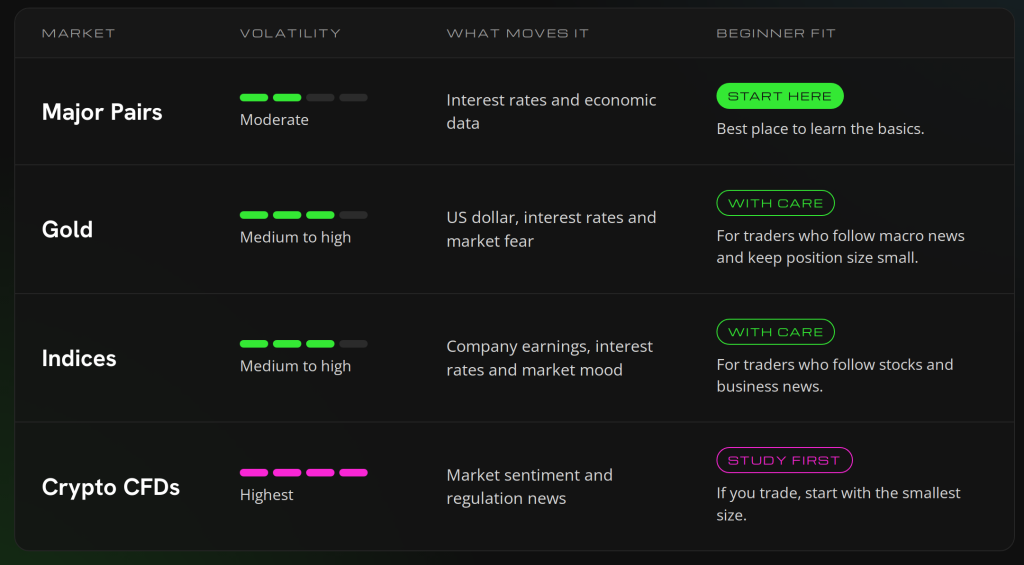
The Report Card: Comparing the Four Groups
Here’s a quick summary of each market’s personality:
How to Pick Your Market
So which market is right for you? Ask yourself four questions:
- When are you free to trade? A trader in Dubai with a day job and free evenings lines up well with the US session, where indices and gold get busy. We’ll map this out properly in Chapter 4.
- How much movement do you handle well emotionally? If a $200 swing in ten minutes makes your heart race, stay away from gold and crypto for now.
- Which news do you already follow? If you read tech news every morning, the NASDAQ might feel natural. If you follow central banks, the majors fit.
- Do the numbers work with your account? Check pip or point values and contract sizes against your daily loss limit before you place a trade.
A final piece of advice from years of watching students: pick one or two markets and learn them deeply. Traders who jump between ten symbols usually end up understanding none of them.
Up Next: Chapter 4
Stay tuned, because the next chapter tackles a question most beginners never think to ask: when should you trade? The forex market runs 24 hours a day, but trading activity rises and falls throughout the day. You’ll learn about the Sydney, Tokyo, London and New York sessions, why the London and New York overlap brings the biggest volume, and why a trade placed at 3 p.m. Dubai time behaves differently from one placed at 3 a.m. Picking the right hour matters as much as picking the right market. See you in class.
Disclaimer: This content is for educational purposes only and does not constitute financial advice. Trading forex and CFDs involves significant risk of loss. Figures used in examples are for illustration only. Contract sizes, point values and available instruments vary by broker and account. Moneta Funded accounts use simulated capital for evaluation purposes
Share:


